


The White House and Office of the U.S. Trade Representative on Feb. 19 announced the finalization of a reciprocal trade agreement with Indonesia that is expected to boost demand for U.S. ethanol exports.

Practical Guidance for Ethanol Producers

The U.S. EPA on Feb. 19 released data showing five additional SRE petitions have been filed under the RFS during the past month. A total of 31 SRE petitions are currently pending, up from 26 that were pending as of mid-January.

The House Committee on Agriculture on Feb. 13 released a draft Farm Bill that includes provisions that aim to expand the use of biochar and encourage growth and innovation in the biofuel, bioproducts and bioenergy industries.

Growth Energy, the National Corn Growers Association, and the Renewable Fuels Association released a joint statement regarding the lack of progress toward a permanent, legislative fix offering consumers year-round access to E15.

The ICGA and IRFA on Feb. 17 called on congress and President Trump to approve nationwide, year-round E15 after the recently formed Rural Domestic Energy Council missed its Feb. 15 deadline to issue an E15 approval framework.

On Feb. 16, Iowa Secretary of Agriculture Mike Naig urged the U.S. House of Representatives’ Rural Domestic Energy Council to find agreement to make year-round E15 available to drivers around the country.

The U.S. EPA on Feb. 12 published a final rule rescinding the agency’s 2009 Greenhouse Gas Endangerment Finding, which formed the legal basis for the EPA’s GHG regulations, and repealed all subsequent GHG emission standards for vehicles.

U.S. Grains & BioProducts Council members gathered Feb. 11-13 for the 23rd International Marketing Conference and 66th Annual Membership Meeting in Panama City. The theme for this year’s event is “The Time is Now!”

Growth Energy on Feb. 12 welcomed industry leaders and innovators to the organization’s 17th annual Executive Leadership Conference. Growth Energy CEO Emily Skor kicked off the conference with a keynote address.

The March issue of Ethanol Producer Magazine focuses on ethanol distillation, dehydration and evaporation; the potential market for marine biofuels; and U.S. EPA compliance for corn kernel fiber ethanol production.

Growth Energy CEO Emily Skor discusses the organization's 2025 achievements and looks forward to what's to come in 2026.

Andrea Kent, past president and board director of Renewable Industries Canada, highlights the need for strong biofuel policy on both sides of the border.

The DOE on Feb. 3 announced the chair and members of the newly established Office of Science Advisory Committee, a unified advisory body that will provide independent advice on complex scientific and technical challenges.

A former U.S. EPA inspector explains how and why corn kernel fiber D3 RIN producers should prepare for potential inspections.

Growth Energy on Feb. 5called on lawmakers to act swiftly on E15 following another disappointing farm income forecast from the USDA. Adoption of year-round E15 could boost demand for corn by up to 2.4 billon bushels.
Renewable fuel producers are ready, willing and able; need policy certainty and new tools to unlock next wave of growth

By Iowa Renewable Fuels Association
February 05, 2026
Iowa Renewable Fuels Association Executive Director Monte Shaw told attendees at the Iowa Renewable Fuels Summit that America’s ethanol and biodiesel producers are “ready, willing, and able” to meet demand.

Forty farm and agricultural groups, and growing, on Feb. 5 launched the Agricultural Coalition for the United-States-Mexico-Canda Agreement, underscoring the accord’s vital role as an economic engine for the U.S. farm economy

Sen. Jerry Moran, R-Kan., on Feb. 2 introduced the bipartisan Securing America’s Fuels (SAF) Act. The bill aims to reinstate the 45Z clean fuel production credit premium for sustainable aviation fuel (SAF) and extend the 45Z credit through 2033.

ACE is hosting its 15th annual Washington, DC Fly-in and Government Affairs Summit March 17-18, 2026, bringing ethanol producers, farmers, and industry stakeholders to Capitol Hill to engage directly with federal policymakers.
The U.S. EPA on Feb. 3 published a notice announcing its approval of a request submitted by Ohio to reinstate the 1-psi volatility waiver within the state. The approval means Ohio has reversed course on a previous plan to allow year-round E15 sales.

The U.S. Department of Treasury and IRS on Feb. 3 released proposed regulations for the 45Z clean fuel production tax credit, as updated by the One Big Beautiful Bill in mid-2025. A public comment period is scheduled to be open for 60 days.
The Office of the U.S. Trade Representative announced the U.S. has signed another agreement on reciprocal trade, this one with El Salvador. According to USGBC, DDGS exports to the country are up 98%.

U.S. Trade Representative Jamieson Greer on Jan. 30 signed a reciprocal trade agreement with Guatemala. Under the agreement, Guatemala will implement a E10 blend mandate and endeavor to purchase at least 50 MMgy of U.S. ethanol
A broad coalition of trade groups representing ethanol producers, petroleum refiners, farmers, and retailers sent a letter to the co-chairs of the new E15 Rural Domestic Energy Council calling for swift action on E15.

Arva on Jan. 27 announced the expansion of its biofuels offering to support biofuel producers as they operationalize the 45Z Clean Fuel Production Credit.
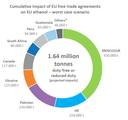
The EU’s decision to safeguard sensitive agricultural sectors such as ethanol and sugar against additional tariff removal in the EU-India trade deal sends a clear signal about the strategic importance of domestic renewable ethanol production.
President Donald Trump on Jan. 27 called on Congress to pass legislation allowing nationwide year-round sales of E15, noting it would sign the bill “without delay.” He made the remarks during a campaign-style rally held in Iowa.

The U.K. Department of Transport on Jan. 20 announced plans to offer up to £43 million ($59.53 million) to support green aviation projects, including those focused on clean fuels and zero-emission aircraft.

The White House Office of Management and Budget on Jan. 23 concluded its review of a proposed rule to implement guidance for the 45Z clean fuel production credit, according to information posted to the agency’s website.
Advertisement

@ Copyright 2026 - BBI International - All rights reserved.