


The Coalition for Renewable Natural Gas and American Fuel & Petrochemical Manufacturers in September filed separate lawsuits challenging the U.S. EPA’s final rule to partially waive 2024 cellulosic blending obligations under the RFS.
World’s largest International Fuel Ethanol Workshop & Expo announces 2026 dates

By BBI International
August 18, 2025
Ethanol Producer Magazine has announced the 42th annual International Fuel Ethanol Workshop & Expo (FEW) will take place on June 2-4, 2026, at the America’s Center in St. Louis, Missouri.
RYAM and GranBio sign MOU to explore cellulosic SAF project at Jesup facility

By Rayonier Advanced Materials Inc.
August 01, 2025
Rayonier Advanced Materials Inc. on July 31 announced the signing of a MOU with GranBio LLC to jointly explore the development of a small-scale commercial cellulosic sustainable aviation fuel (SAF) facility co-located at RYAM’s Jesup, Georgia site.

While final IRS guidance is still pending, the foundation of the 45Z program is well defined. Clean fuel producers should no longer be waiting; they can now move forward with critical planning and preparation, according to EcoEngineers.

The U.S EPA on July 17 released data showing more than 1.9 billion RINs were generated under the RFS during June, down 11% when compared to the same month of last year. Total RIN generation for the first half of 2025 reached 11.17 billion.
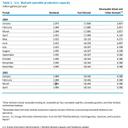
U.S. fuel ethanol capacity fell slightly in April, while biodiesel and renewable diesel capacity held steady, according to data released by the U.S. EIA on June 30. Feedstock consumption was down when compared to the previous month.

The U.S. EPA on July 8 hosted virtual public hearing to gather input on the agency’s recently released proposed rule to set 2026 and 2027 RFS RVOs. Members of the biofuel industry were among those to offer testimony during the event.

President Trump on July 4 signed the “One Big Beautiful Bill Act.” The legislation extends and updates the 45Z credit and revives a tax credit benefiting small biodiesel producers but repeals several other bioenergy-related tax incentives.
The U.S. EPA on June 18 announced 1.75 billion RINs were generated under the RFS in May, down from 2.07 billion that were generated during the same period of last year. Total RIN generation for the first five months of 2025 reached 9.06 billion.

Blue Biofuels has annoucned the issuance of a new U.S. patent, further strengthening the company’s expanding intellectual property portfolio. This latest patent brings the company’s total number of granted patents to seven.
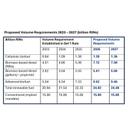
The U.S. EPA on June 13 released a proposed rule to set strong 2026 and 2027 RFS RVOs. The rulemaking also aims to limit the participation of imported fuels and feedstocks, eliminate eRINs, and reduce the 2025 cellulosic RVO.

The U.S. EPA on June 13 released a final rule reducing the 2024 RFS renewable volume obligation (RVO) for cellulosic biofuel to 1.01 billion renewable identification numbers (RINs). The rule also revises RFS regulations related to biogas.

The White House OMB on June 11 concluded its review of two RFS rulemakings, including a proposed rule to set new renewable volume obligations (RVOs) and a final rule for a partial waiver of the 2024 cellulosic RVO.

The U.S. EPA on May 15 released data showing nearly 1.79 billion RINs were generated under the RFS in April, down from 2.09 million generated during the same month of last year. Total RIN generation for the first four months of 2025 was 7.12 billion.
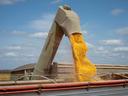
A surge in corn kernel fiber as a feedstock is sweeping the industry, driven by incentives for low carbon intensities and EPA-approved testing methods for D3 RIN qualification.

Scientists at Washington State University have found a new way to produce sugar from corn stalks and other crop waste, potentially opening a new pathway to sustainable biofuels. The experimental process used ammonium sulfite-based alkali salts.

Ethanol Producer Magazine has announced the keynote speakers for the 2025 International Fuel Ethanol Workshop & Expo (FEW) being held June 9-11, 2025, at the CHI Health Center in Omaha, Nebraska. The general session will take place June 10.

Reps. Mike Carey, R-Ohio, and Mariannette Miller-Meeks, R-Iowa, on May 1 introduced legislation that aims to retroactively extend the biodiesel blenders tax credit (BTC) and the second-generation biofuel producer tax credit.

Edeniq utilizes analytical expertise to support ethanol producers in their pursuit of a lower-carbon gallon and elusive, lucrative cellulosic ethanol.

The Florida Senate Community Affairs Committee on March 17 voted 5 to 3 to advance a bill that supports efforts to develop a proposed 7.5 MMgy cellulosic ethanol plant in Fernandina Beach, Florida, by Rayonier Performance Fibers LLC.

The U.S. EPA on March 7 announced it will extend the compliance year 2024 Renewable Fuel Standard reporting deadline and signaled its intent to revise the 2024 RFS renewable volume obligation (RVO) for cellulosic biofuel.

A testing change adopted by EPA’s efficient producer pathway program is attracting producers with the means to generate D3 RINs from corn kernel fiber ethanol.

Comstock Inc. on Feb. 28 announced a new $14 million investment and strategic collaboration with Marathon Petroleum Corp. to advance its lignocellulosic biomass refining solutions to commercial maturity.

Nippon Paper Industries Co. Ltd., Sumitomo Corp., and Green Earth Institute Co. Ltd. have announced plans to form a JV, Morisora Bio Refinery LLC, which will focus on the production and sale of ethanol and chemicals from woody biomass.
Comstock Inc. on Jan. 30 announced the execution of definitive agreements between Comstock Fuels Corp. and SACL Pte. Limited, a Singapore-based renewable fuel project developer, related to projects in Australia, New Zealand, Vietnam and Malaysia.

New Energy Blue’s cellulosic ethanol refinery planned for Iowa is backed by Scandinavian technology partnerships, ongoing U.S. research into corn stover and a focus on front-end problem-solving.

Blue Biofuels has signed an agreement to acquire 35.5 acres of land in Frostproof, Florida. The company plans to develop a 3 MMgy facility on the site. Planned expansion projects would boost capacity to 100 MMgy of cellulosic ethanol and SAF.

Rep. Beth Van Duyne, R-Texas, on Jan. 16 introduced a bill that aims to repeal the Section 45Z clean fuel production credit. The tax credit, established by the IRA, supports the production of various low-carbon transportation fuels.

Brazilian ethanol producer Raizen on Jan. 17 announced its pilot-scale second generation ethanol plant in Piracicaba, São Paulo, will discontinue recurring operations on April 1 and transition to a testing and R&D facility.

Growth Energy on Jan. 21 submitted a comment to the U.S. EPA urging the agency not to proceed with a proposal to partially waive the 2024 cellulosic biofuel volume requirement under the Renewable Fuel Standard.
Advertisement

@ Copyright 2026 - BBI International - All rights reserved.