


Aemetis Inc. released fourth quarter financial results on March 7, reporting the company achieved important milestones in its biodiesel, RNG, ethanol, SAF and carbon capture business segments last year.

Gevo Inc. has reported that efforts are continuing to secure a U.S. DOE loan guarantee to support the construction of its proposed SAF facility. Gevo also reported that its RNG project in Iowa operated at 91% capacity during Q4.

By creating optimal conditions to maximize corn oil output, Fluid Quip Technologies’ pretreatment system gives ethanol producers an unfussy method to maximize production.
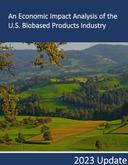
USDA on March 8 celebrated the second annual National Biobased Products Day, a celebration to raise public awareness of biobased products, their benefits and their contributions to the U.S. economy and rural communities.

The U.S. exported 149.97 million gallons of ethanol and 902,376 metric tons of distillers grains in January, according to data released by the USDA FAS on March 7. Exports of both products were up when compared to January 2023.

Nissan Motor Co. Ltd. On March 5 announced that it has developed a stationary, bio-ethanol-fueled system capable of high-efficiency power generation. Trials of the system have begun at Nissans Tochigi Plant in Japan.
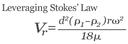
Disc stack centrifuges and tricanters are familiar and effective tools in distillers corn oil (DCO) extraction. However, challenges arise from upstream processes and over 50 unique plant variables, influencing optimal extraction.
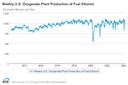
U.S. fuel ethanol production was down approximately 2% the week ending March 1, according to data released by the U.S. Energy Information Administration on March 6. Ethanol stocks were up slightly and exports were up 45%.

The RFA has added Kendra Coulson as the association’s new marketing and membership manager. RFA also promoted Mary Giglio to vice president, events and initiatives and Robert White to senior vice president, industry relations and market development.

Summit Carbon Solutions announced on March 4 that Valero, the world’s second-largest corn ethanol producer and a leader in low-carbon transportation fuels production, will be a shipper on Summit’s pipeline.

Spraying Systems Co., a seasoned partner to the ethanol industry, has expanded its offering of fermentation tank cleaning technology.

Red Trail Energy LLC and Puro.earth on March 5 announced issuance of RTE’s CO2 removal credits on the Puro Registry, making it the first ethanol production facility to generate CO2 Removal Certificates in the voluntary carbon market.

Aemetis Inc. on March 5 announced receipt of the Authority to Construct air permits for its planned sustainable aviation fuel (SAF) and renewable diesel (RD) production plant in Riverbank, California.

U.S. EPA Administrator Michael Regan on March 1 announced the launch of the agency’s Office of Agriculture and Rural Affairs during an appearance at the 2024 Commodity Classic in Houston, Texas.
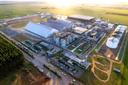
FS has received the ISCC international certification attesting that its production process meets international requirements for the production and supply of ethanol and corn oil for the production of SAF.
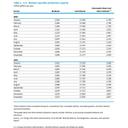
Total U.S. operable biofuels production capacity fell slightly in December, according to data released by the U.S. Energy Information Administration. Total feedstock consumption was up when compared to both the previous month and December 2022.
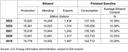
Data released on Feb. 29 by the EIA show that U.S. ethanol production and consumption rose nearly 2% in 2023 to reach their highest levels since 2019, while the blend rate hit a record 10.39%

Sugar Valley Energy, a new 160-acre bioenergy campus planned in California’s Imperial Valley has added New York-based TerraNova Capital Equities, Inc. to its finance team to lead marketing and placement of equity capital for the $1 billion project.
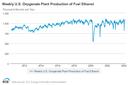
U.S. fuel ethanol production was down less than 1% the week ending Feb. 23, according to data released by the U.S. EIA on Feb.28. Ethanol stocks were up 2%, reaching the highest level since March 2023, and exports were down 55%.

Southwest Airlines Co. has launched Southwest Airlines Renewable Ventures, a wholly-owned subsidiary dedicated to creating more opportunities to obtain scalable SAF. The carrier also announced a $30 million investment in LanzaJet Inc.
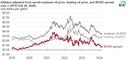
The price of compliance credits for biomass-based diesel and ethanol has decreased about 45% since the start of the year, when prices were already the lowest in about three years, according to the U.S. Energy Information Administration.

The U.S. Department of Energy and the U.S. EPA on Feb. 22 released a funding opportunity announcement (FOA), entitled, “Inflation Reduction Act Funding for Advanced Biofuels,” for up to $9.4 million for the development of advanced biofuels.

The U.S. Grains Council’s Latin America office recently collaborated with several other groups to organize the “Sustainable Mobility: Opportunities of Ethanol in Guatemala” conference in Guatemala City.
Aemetis Inc., an RNG and renewable fuels company focused on negative carbon intensity products, has announced an updated five-year plan that projects the company will generate $1.95 billion in revenues and $645 million of adjusted EBITDA in 2028.
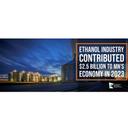
A study by the University of Minnesota Extension shows the ethanol industry contributed $2.5 billion to Minnesota’s GDP in 2023. The industry produced 1.35 billion gallons of ethanol, which in turn resulted in $6.6 billion of economic activity.

Novonesis, formerly Novozymes, has introduced new yeast technology— Innova Delta, which allows plants using non-GM yeasts to achieve operational performance on par with their global peers using the most advanced GM yeasts.
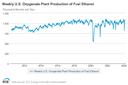
U.S. fuel ethanol production was up slightly the week ending Feb. 16, according to data released by the U.S. Energy Information Administration on Feb. 22. Ethanol stocks were down more than 1% and exports were up nearly 59%

Raízen, an integrated energy company, and Wärtsilä, the global leader in power system technologies for marine and energy markets, signed a decarbonization agreement in order to advance decarbonization of the marine sector.
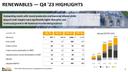
The Andersons Inc. released fourth quarter results on Feb. 20, reporting that the company’s four ethanol plants achieved record production for the three-month period. The Renewables segment also reported record pretax income.

At the National Ethanol Conference in San Diego, the Renewable Fuels Association presented its 2024 Award of Excellence to Dr. Michael Wang, an Argonne National Laboratory distinguished fellow and senior scientist.
Advertisement

@ Copyright 2026 - BBI International - All rights reserved.