


As Indonesia moves toward implementing ethanol blending as part of its broader energy transition strategy, the USGBC recently partnered with Pertamina New & Renewable Energy to formalize collaboration through a MOU signing in Jakarta.

Gevo Inc. on April 15 withdrew its application for a U.S. Department of Energy loan guarantee to support its proposed alcohol-to-jet project. The company signaled its intent to continue developing a 30 MMgy SAF project in North Dakota.

Nearly 1.93 billion RINs were generated under the RFS in March, up 1% when compared to March 2025, according to data released by the U.S. EPA on April 16. Total RIN generation for the first three months of the year reached nearly 4.9 billion.
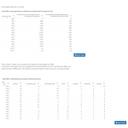
The U.S. EPA on April 16 published data showing no new small refinery exemption (SRE) petitions have been filed under the Renewable Fuel Standard in the past month. A total of 37 SRE petitions are currently pending.
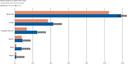
U.S. ethanol exports in marketing year (MY) 2025/2026 now total more than 1 billion gallons, up 13% year over year, and on pace to surpass last year’s record of 2.1 billion gallons, according to a recent data release from the USDA.

The global maritime industry's transition away from heavy fuel oil is no longer a question of if but of when — and with what fuels. The U.S. biofuels industry is exceptionally well-positioned to serve this transition in the near to medium term.
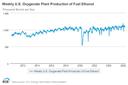
U.S. fuel ethanol production was up slightly the week ending April 10, according to data released by the U.S. Energy Information Administration on April 15. Stocks of fuel ethanol expanded by more than 2% while exports fell by 60%.

President Donald Trump on April 13 signed the Small Business Innovation and Economic Security Act. The legislation reauthorizes the Small Business Innovation Research (SBIR) and Small Technology Transfer (STTR) programs.

CoBank on April 8 released its latest quarterly research report, highlighting improved regulatory clarity for the biofuel industry with the release of the Renewable Fuel Standard “Set2” rule, which set 2026 and 2027 RFS RVOs.

With E15 remaining a top priority to help American families cope with soaring fuel prices, the RFA offers a slate of information to remind lawmakers, ethanol advocates, media, and others about the importance of the 15% ethanol blend.

Vale and Shandong Shipping Corp. have announced an agreement for new ethanol-powered Guaibamax vessels. The agreement includes 25-year contracts for the construction of two vessels, with an option for additional ships.

The U.S. Grains & BioProducts Council’s regional office in Latin America (LTA) recently engaged with pork industry leaders and nutritionists to share the value of U.S. distiller’s dried grains with solubles (DDGS) in feed diets.

The California Assembly Transportation Committee on April 7 voted unanimously to advance a bill that aims to allow California drivers to legally install federally approved E85 conversion kits in their vehicles.

The California Senate Budget and Fiscal Review Committee’s Subcommittee 2 on Resources, Environmental Protection and Energy on April 9 heard testimony focused on California. Gov. Gavin Newsom’s proposed SAF tax credit.

The USDA is formally rescinding a notice of funding opportunity issued in October 2024 for FY 2025, 2026 and 2027 Rural Energy for America Program funding. Any applicant without a fully executed financial assistance agreement will have to reapply.

Honeywell on April 14 announced that Petrobras has selected Honeywell UOP’s ethanol-to-jet (ETJ) process technology for a 10,000-barrel-per-day SAF project at its REPLAN refinery in São Paulo, Brazil.

Vault 44.01 Ltd. on April 9 announced that the U.S. EPA Region 5 has issued a final Class VI permit for the One Carbon Partnership CCS project near Union City, Indiana. One Carbon Partnership is a joint venture between Cardinal Ethanol and Vault.

The USGBC recently participated in the USDA Reciprocity for U.S. Manufacturers and Producers trade mission to Vietnam, where the delegation engaged with key coarse grain and co-product stakeholders in Ho Chi Minh City and Hanoi.

Reps. Michelle Fischbach, R-Minn., and Nikki Budzinski, D-Ill., on March 27 introduced the Biobased Materials Investment and Production Act, which aims to create tax incentives to support the production of biobased chemicals and materials.

The USDA maintained its forecast for 2025-’26 corn use in ethanol production in its latest World Agricultural Supply and Demand Estimates report, released April 9. The estimated season-average corn price received by produced was raised slightly.
The USDA’s data, analysis and research are the “gold standard” among international statistical agencies for agriculture, the RFA said in comments submitted in response to a USDA request for information.

MN Bio-Fuel is encouraging fuel retailers to apply for new grant funding from the Minnesota Department of Agriculture’s Agricultural Growth, Research, and Innovation Bio-Fuels Infrastructure Program to expand access to E15, also known as Unleaded 88.
On April 7, U.S. Department of Agriculture Rural Development Montana State Director Bill Warden announced the agency is investing in the future of Montana’s biofuel industry through Beaverhead Tourism Council in Dillon, Montana.
Improved catalyst enhances the conversion of ethanol to hydrogen

By Fundação de Amparo à Pesquisa do Estado de São Paulo
April 10, 2026
A study led by Fabio Coral Fonseca, a senior researcher at the Institute of Energy and Nuclear Research, demonstrated that fine-tuning the processing of a perovskite-type ceramic catalyst is crucial for maximizing the conversion of ethanol into hydrogen.
Zemo Partnership launches RFAS Aviation to strengthen the verification of SAF traceability in the UK

Zemo Partnership on March 30 announced the launch of RFAS Aviation, a new voluntary assurance scheme designed to provide independent verification of sustainable aviation fuel (SAF) across the U.K. supply chain.


The global maritime sector is massive. Its annual fuel consumption is roughly three times larger than global ethanol production. But today, virtually no renewable fuels are used in maritime.

The USDA on April 7 announced it has awarded six grants worth a combined $4.17 million under the Higher Blends Infrastructure Incentive Program to support expanded ethanol and biodiesel availability and use in Iowa.

A catalyst developed by a Washington State University research team efficiently converts abundant, renewable ethanol into valuable molecules needed for production of plastics, fuels, and everyday products.

The USDA on April 7 finalized a rule modernizing the National Environmental Policy Act regulations. The final rule consolidated seven agency-specific NEPA regulations into a single, department wide framework.
Advertisement

@ Copyright 2026 - BBI International - All rights reserved.