


The U.S. Department of Commerce’s International Trade Administration on Feb. 12 announced it would postpone a meeting of the Renewable Energy and Energy Efficiency Advisory Committee that was scheduled to take place that day.

The ethanol industry’s contribution to the U.S. economy remained “robust” last year, as record-setting production offset the impact of lower commodity prices, according to a report released Feb. 17 by the Renewable Fuels Association.

The Renewable Fuels Association released its 2025 Ethanol Industry Outlook and Pocket Guide today as a kickoff to the 30th annual National Ethanol Conference, taking place Feb. 17-19 in Nashville, Tennessee.
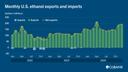
The U.S. ethanol industry is positioned to continue capitalizing on growing global demand for ethanol, but export market headwinds could be on the horizon, according to a new report published by CoBank.

Aemetis Inc. on Feb. 14 announced that cumulative revenues generated by the Aemetis ethanol plant in California passed the $2 billion milestone. The company also expects improved cash flows from the MVR energy efficiency project.

POET and Tallgrass on Feb. 13 announced they have entered into definitive agreements to connect POET’s Fairmont, Nebraska, bioprocessing facility to the Tallgrass Trailblazer carbon dioxide (CO2) pipeline.

On Jan. 30, Rep. Nikki Budzinski, D-Ill, visited the National Corn-to-Ethanol Research Center at Southern Illinois University Edwardsville to tour the ethanol research pilot plant that specializes in advancing biofuels.

The U.S. agricultural industry is a global leader in high-quality, affordable feed grains and their co-products including biofuels like ethanol and feed additives like distillers dried grains with solubles (DDGS).
Comstock Inc. on Feb. 4 announced that its subsidiary, Comstock Fuels Corp. was approved by the Oklahoma State Treasurer’s Office to issue up to $152 million in qualified private activity bonds.

Key players in Europe’s aviation industry, including airlines, airports and manufacturers have outlined to EU policymakers seven critical measures to stimulate sustainable aviation fuel (SAF) production in Europe.

In January, the USGC and the NCGA jointly held the 1st Corn Sustainability Strategy Session to discuss the U.S. corn industry’s plans to leverage its sustainable practices and respond to market requirements across domestic and global supply chains.

Growth Energy identifies specific policy goals and actions the 119th Congress and the incoming Trump administration should take to unleash American energy dominance through the expanded use of homegrown American ethanol.

In December, USGC Regional Ethanol Manager for the European Union, United Kingdom and Canada Stephanie Larson was in Calgary, Alberta in Canada to meet with leading fuel refiners and blenders to discuss their biofuel integration plans.

Comstock Inc. on Jan. 30 announced the execution of definitive agreements between Comstock Fuels Corp. and SACL Pte. Limited, a Singapore-based renewable fuel project developer, related to projects in Australia, New Zealand, Vietnam and Malaysia.

The March issue of Ethanol Producer Magazine focuses on low-carbon feedstock production, plant improvement projects, and New Energy Blue's cellulosic project.

A revamped distillation system offers producers the potential to reduce steam usage, produce high-purity alcohol and lower overall carbon intensity score.

The U.S. and Canada are both at political crossroads. Policies that deliver real economic, environmental and rural benefits will take center stage—and ethanol is uniquely positioned to deliver.

Ginkgo Bioworks on Jan. 23 announced that Ginkgo Automation will design and deploy a flexible, anaerobic-enabled laboratory automation system for the Great Lakes Bioenergy Research Center, a U.S. DOE-funded facility at UW–Madison.

New Energy Blue’s cellulosic ethanol refinery planned for Iowa is backed by Scandinavian technology partnerships, ongoing U.S. research into corn stover and a focus on front-end problem-solving.

Scoular is the new formalized supplier of grain and logistics to Mid America Agri Products/Wheatland’s ethanol plant in southwestern Nebraska. Scoular operates an extensive origination network in western Nebraska.
The California Air Resources Board has approved point-of-origin feedstock tracking requirements for crop-based biofuels, adding appeal to emerging traceability technologies and programs.

Mycotoxin testing offers producers the necessary details on contamination levels in the corn entering the plant and the DDGS leaving it.
PyroGenesis Inc. has announced that its subsidiary, Pyro Green-Gas Inc., has signed a $1.1 million second contract with the Varennes Carbon Recycling plant, a large biofuel production project currently under construction in Varennes, Quebec.

On Feb. 6, the Iowa Renewable Fuels Association sent a letter signed by 2025 Iowa Renewable Fuels Summit attendees to U.S. House Speaker Mike Johnson and U.S. Senate Majority Leader John Thune, calling for an immediate fix for year-round E15.
Advanced waste heat integrated heat pump application reduces distillation and slurry steam use by over 80%.

Verity Holdings LLC, a subsidiary of Gevo Inc., and Landus have announced a new agreement aimed at unlocking added value for farmers through sustainability premiums via export markets.

New markets, export opportunities and policy changes are all things that will help build demand, said IRFA Executive Director Monte Shaw at the Iowa Renewable Fuels Summit. The nearest term demand driver should be year-round E15, he added.

Brazil produced a record 36.83 billion liters (9.73 billion gallons) of ethanol in 2024, up 4.4% when compared to the previous year, according to data released by UNICA, the Brazilian sugarcane industry association.

The U.K. Department for Transport has announced it will invest £63 million over the next year under its Advanced Fuels Fund to support SAF producers. The agency also issued a response to its consultation on a revenue certainty mechanism for SAF.

Summit Carbon Solutions and Infinium, a leading electrofuels (eFuels) producer, have entered an arrangement for the supply of up to 670,000 metric tons of CO2 annually at a proposed eFuels facility in North Dakota or South Dakota.
Advertisement

@ Copyright 2026 - BBI International - All rights reserved.